

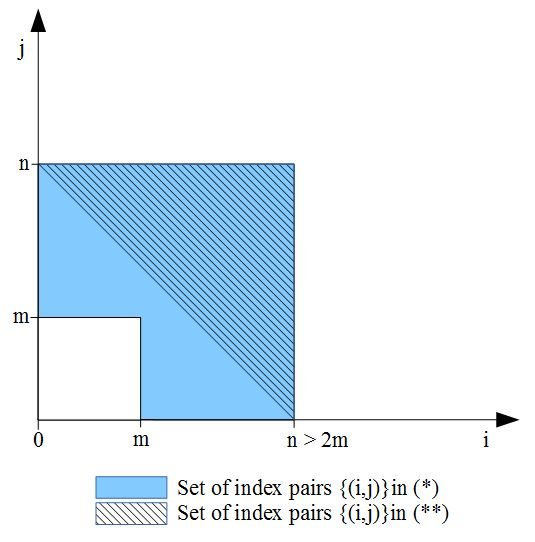
Proof (related to "Cauchy Product of Absolute Convergent Series")editcontribute as guest [id:1396]We begin the proof with a number of definitions: We set \[\begin{array}{c} The proof is in two steps: \( (1) \) We will first show that \(\lim_{n\to\infty} C_n=A\cdot B\).By hypothesis, \(A\) and \(B\) are absolutely convergent series, which by definition means that \(\sum_{n=0}^\infty |a_n|\) and \(\sum_{n=0}^\infty |b_n|\) are convergent series. Due to the rule of the product of convergent sequences, it follows that the real sequences \((D_n^*)_{n\in\mathbb N}\) is a convergent sequence. This in turn means by definition that for a fixed \(\epsilon > 0\) there is an index \(m\in\mathbb N\) with Note that if \( n > 2m \), then1 We will use this as an interim result. Now, observe that1 first: Now, once again since \(A\) and \(B\) are absolutely convergent series, they are in particular convergent. Therefore, the real sequences of their partial sums \((A_n)_{n\in\mathbb N}\) and \((B_n)_{n\in\mathbb N}\) are convergent sequences with \(\lim A_n=A\) and \(\lim B_n=B\). Like in the reasoning above, due to the rule of the product of convergent sequences, we have
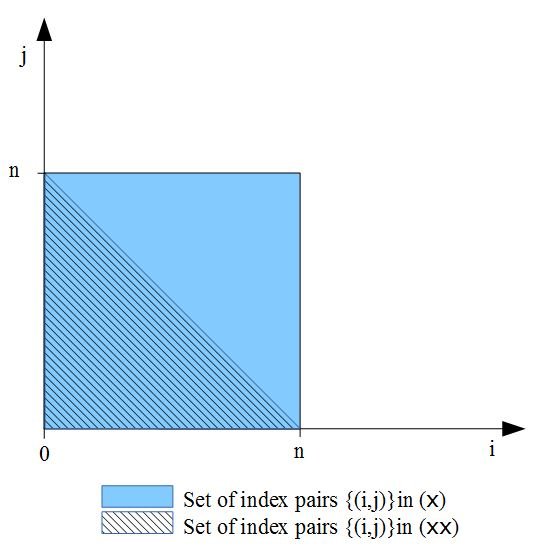
This is a pure geometric argument, since for \(n > 2m\) the hatched area is totally included in the blue area. Therefore, we have \(\lim_{n\to\infty} (D_n - C_n)=0,\) and \(\lim_{n\to\infty} C_n=A\cdot B\). \( (2) \) It remains to be shown \(\sum_{n\to\infty} c_n\) is absolutely convergent.We have to show that \(\sum_{n\to\infty}|c_n|\) is convergent. It has already been shown that the real sequence \((D_n^*)_{n\in\mathbb N}\) is a convergent sequence. Moreover, we have in the Iverson notation \[D_n^*=\sum_{i,j} |a_i||b_j|[0\le i\le n\wedge 0\le j\le n].\quad\quad ( \times )\] On the other hand, it follows from the triangle inequality that Following a similar geometric argument as above, the set of of possible index pairs \(\{(i,j)\}\) in the sum \( ( \times\times ) \) is included in the set of index pairs \(\{(i,j)\}\), which are possible in the sum \( ( \times ) \) - see following figure
Therefore, we have \[\sum_{k=0}^n |c_k|\le D_n^*\] 1 In the last two steps, and in the following text, the Iverson notation for sum is used, which turns out to be very helpful in sum manipulation steps. q.e.d References [581] Forster Otto: “Analysis 1, Differential- und Integralrechnung einer Veränderlichen”, Vieweg Studium, 1983 Contribute to BoP: add a new Open Problem addcontribute as guest add a new Comment (Branch) addcontribute as guest |
The contents of book of proofs are licensed under the Creative Commons Attribution-ShareAlike 3.0 Unported License.