

Explanation: What is special about transitive sets?deleteeditadd to favorites[id:726]vote: last edited 0 min ago by bookofproofs The defining principle of transitive sets is that its elements are also its subsets, i.e. if from \(Y\in Z\) it follows that \(Y\subseteq Z\), then \(Z\) is transitive. This is equivalent to the following: If \(Y\subseteq Z\), then each element \(X\in Y\) is also an element of \(X\in Z\). So altogether, transitivity means nothing else then \[X\in Y\wedge Y\in Z\Longrightarrow X\in Z.\] Let us consider some examples to get a better idea what it means. Example 1 - Elements of the infinite Zermelo setZermelo used a special set to postulate his axiom of infinity. Let us consider the first elements of this set. We find that only the first two elements are transitive, all other are not:
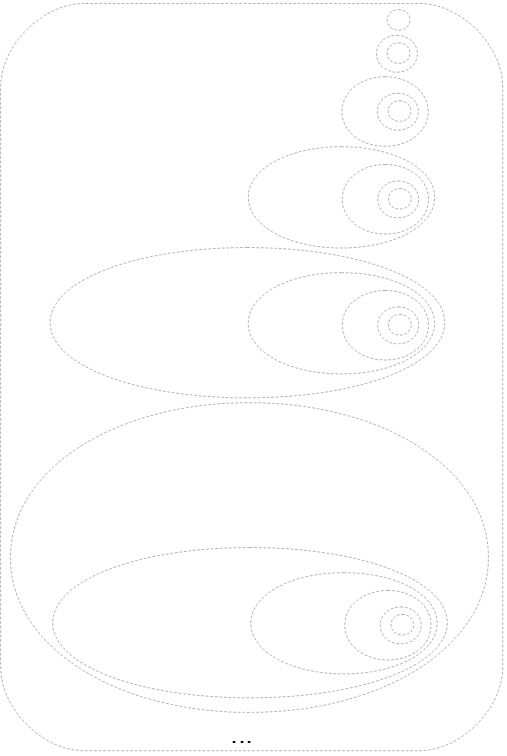
Example 2 - Elements of the infinite Zermelo set - revisedWe can, however, construct transitive sets \(T_n\) from the elements of the Zermelo set, which are \(X_0:=\emptyset,~X_n:=\{X_{n-1}\}\), by combining any first \(n\) of them into new sets according to the following rule: \(T_0:=X_0,~T_n:=\bigcup_{0\le k\le n} X_k\).
Example 3 - Elements of the infinite von Neumann setAnother example of transitive sets are the elements of the von Neumann set used to axiomatically postulate the existence of infinity:
It is no accident that by consequently re-applying the construction principles fort transitive sets we inevitably come out with infinite many different transitive sets. The transitive sets open the door into the systematical study of infinite sets, which is a fascinating journey beyond our imagination. Further Reading [656] Hoffmann, Dirk W.: “Grenzen der Mathematik - Eine Reise durch die Kerngebiete der mathematischen Logik”, Spektrum Akademischer Verlag, 2011 Contribute to BoP: |
The contents of book of proofs are licensed under the Creative Commons Attribution-ShareAlike 3.0 Unported License.