A circle is a plane figure contained by a single line [which is called a circumference], (such that) all of the straight lines radiating towards [the circumference] from one point amongst those lying inside the figure are congruent to one another.
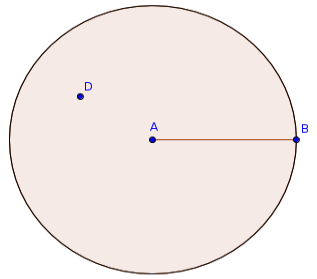
Let \(A,B\) be two different points in a plane \(\mathcal P\), and let \(d(A,B)\) denote their Euclidean distance (i.e. the length of the segment \(\overline{AB}\)). A circle is a plane figure consisting of points of the plane \(D\), which have a smaller or equal distance from \(A\), formally
\[\text{Circle}:=\{D\in\mathcal P:~d(A,D)\le d(A,B)\}.\]
Any segment \(\overline{A,D}\) with maximum possible distance \(d(A,D)=d(A,B)\) is called the radius of the circle.
The circumference of the circle is the boundary of the circle, i.e. all points \(D\) in the plane, which have the maximum possible distance:
\[\text{Circlumference}:=\{D\in\mathcal P:~d(A,D) = d(A,B)\}.\]
A circle with a radius \(\overline{AB}\). In the figure, one of the infinitely many points \(D\) with \(d(A,D)\le d(A,B)\) is marked.
 |
|  |
|  |
|  |
|  | created: 2014-06-14 19:46:05 | modified: 2019-08-20 20:41:32 | by: bookofproofs | references: [626], [628], [6419]
[626] Callahan, Daniel: “Euclid’s ‘Elements’ Redux”, http://starrhorse.com/euclid/, 2014
[6419] Fitzpatrick, Richard: “Euclid’s Elements of Geometry”, http://farside.ph.utexas.edu/Books/Euclid/Euclid.html, 2007
[628] Casey, John: “The First Six Books of the Elements of Euclid”, http://www.gutenberg.org/ebooks/21076, 2007